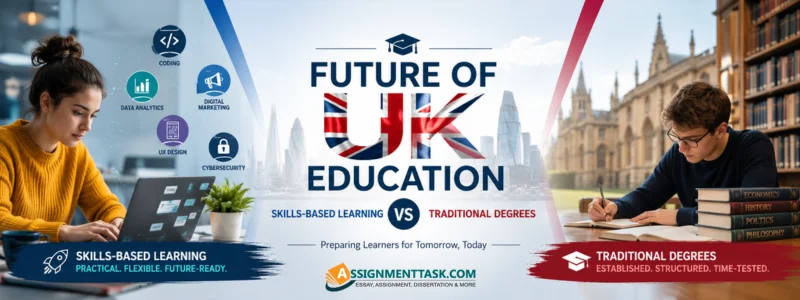
Future of UK Education: Skills-Based Learning vs Traditional Degrees
- Assignment Task Blog
- Jun 05, 2026
- Academic Writing
The future of education in the UK is changing faster than it ever has. As industries adopt technology, automation, and new ways of working, employers are now looking beyond traditional qualifications to find talent with real-world skills. But in 2026, students are asking an important question: Is a university degree still the best route to success, or can skills-based learning offer a quicker, more hands-on path to a rewarding career? With online certifications, industry-focused training, and apprenticeships becoming more popular, the education landscape is changing to meet the needs of a modern workforce.
Let's dive deeper into this shift and explore how skills-based learning compares to traditional degrees in 2026. If you are a student considering your options or an individual who needs help with assignments in UK, we are here to answer all your queries. In this blog, we'll analyze the opportunities, challenges, and future of UK education so you can make informed choices.
Get the academic support you need and take the next step toward achieving your educational goals with confidence.
Overview of the UK Education System in 2026
The UK education system in 2026 is seeing a significant shift towards digitally fit learning. It is built on AI integration and a strong vocational pathway, with an expected investment of 800 million pounds in education for 16 to 19 year-olds.
The higher education trends in the UK maintain their own structure in the very early years, with the primary, secondary, and higher secondary education systems. With more focus on a skill-based learning system.
The key skills-based learning in the UK is as follows:
-
Post 16 focus: thesis on the intricacies of technical excellence colleges, along with the V levels, to aim at strengthening vocational training VG.
-
Technology and curriculum: more schools are now adopting AI coding and data science into the study curriculum, along with digital abetment tools.
-
Structure: the compulsory education period remains up to 18, with a strong focus on making math the foundation of early education systems (EYFS).
-
International education strategy: the UK education strategy in 2026 emphasizes transitional education (TNE) and the expansion of the UK's presence in overseas markets, alongside very strict domain visa regulations.
-
Early Years Foundation Stage (EYFS): primary education 3-4; secondary education 11-16; higher education at a university, undergraduate 3 years, also with postgraduate degrees.
-
Trends and policy changes: they are about safety and accountability, with new education laws aiming to strengthen the system by safeguarding overall accessibility.
-
Funding: an additional investment in the 16-19 education sector.
- International focus: the 2026 practical education in the UK was lauded for bolstering the UK's role in the global talent pipeline.
What is Skills-Based Learning?
The UK's skill-based learning in education and training focuses on acquiring the most specific, practical knowledge demanded by employees rather than only academic knowledge. This prioritizes the most important expenses for vocational training, with all essential skills, such as digital literacy, integrated into the education system, like a digital literacy and problem-solving company via apprentices.
What Are Traditional Degrees in the UK?
The key features include the following:
-
Industry assignment: this training is designed with valuable input from staff to close all skill gaps among sawyers, including construction, technology, and green energy.
-
Kew frameworks: the skid probed a very need; framework for tacking 8 min employability skills- speaking, listening, problem solving, high aiming, staying positive with team and leadership.
-
Practical application: Tug linking occurs via projects and work-based learning.
-
Apprentice: It is a good combination of work and study.
-
Boot camps: flexible courses with a 16-week duration.
- T levels: a technical qualification for 16 to 19-year-olds.

Stuck with Assignment Writing?
Skills-Based Learning vs Degrees: Key Differences
If we want to explain skills vs degree in the UK, the skills-based approach focuses on job-ready skills and practical courses. In contrast, UK degrees offer more comprehensive, theoretically grounded knowledge for a long-term career. The key differences are as follows:
-
Timing and focus: the skill-based training is short-term, more industry-focused, and often lasts a few months. At the same time, degree courses are more academic and offer a longer term, with vocational knowledge, lasting 3-4 years.
-
Hiring and credibility: the degree provides broader, more widely recognized validation across disciplines, and the skill-based training programs provide more concrete evidence of skills through various portfolios and course certifications.
-
Speed and flexibility: skill-based training, such as boot camps and course certificates, is very flexible and self-paced. The degree of use is generally more rigid in online learning and even in hybrid models.
- Cost: the skill-based case is that the pathways are generally more affordable and comparable to the higher cost of a longer university education.
Why Skills-Based Education is Growing in the UK?
The UK's skills-based vocational training is growing rapidly to bridge gaps in industrial skills, especially in the AI (Artificial Intelligence) and digital sectors, as well as in green technologies. It offers a quicker and more affordable alternative to traditional degree courses. This is elaborated as follows:
-
Bridging skill gaps: there is a need to fill local and regional sectors with highly specific skills to boost workforce productivity in the UK.
-
Fast-growing digital economy: With about 56% of technical employers struggling with digital recruitment, skills education is shifting alongside AI, technical labor, and automation technologies.
-
Rise of skill-based hiring: employees in the UK are prioritizing skills over traditional degrees, with a 20% increase in AI technical roles and a near 15% drop in the need for traditional degrees in these roles.
-
Learning and flexibility: the rapidly changing labor market requires constant updates of the necessary skills.
-
ROI and affordability: the skill-based programs in the UK mostly offer lower tuition fees than university degree courses and lead to jobs with SAE or even higher salaries.
- Collaborator of the government and industry: the government's new initiatives for the newly formed industry in the UK aim to align employee skills.

Looking for Free Assignment Samples?
Pros and Cons of Traditional Degrees
Pros of Traditional Degrees:
-
Networking & Social Opportunities: In-person attendance fosters face-to-face connections with peers, professors, and industry experts.
-
Structured Learning Environment: Fixed schedules and in-person interaction provide structure, accountability, and better engagement for many learners.
-
Prestige and Credibility: Traditional, in-person degrees from accredited universities are often preferred by employers and seen as more reputable.
-
Campus Facilities & Experience: Students have access to libraries, labs, gym facilities, and on-campus organizations that aid in personal growth.
- Independent Living & Life Skills: Particularly for younger students, living on campus offers valuable experience in independence and maturity.
Already completed your assignment? Our Editing and Proofreading help services can refine your work by improving clarity, grammar, structure, and overall presentation before submission.
Pros and Cons of Skills-Based Learning
The pros and cons of vocational vs university in the UK are as follows:
Pros of degree courses:
-
Social opportunities and networking: in-person, face-to-face interaction with peers, industry experts, and professors.
-
Credibility and prestige: the traditional deference course from various accredited universities is often preferred by employers.
-
An environment of trusted learning: the fixed schedule and in-person interactions provide more structure and better accountability for learners.
-
Independent life skills: especially for younger students, the chamois life offers more valuable experiences.
- Campus facilities: students have access to the libraries, gym, labs, and all on-campus organizations needed for their personal growth.
Cons of the traditional degrees in the UK:
-
Cost: It is one of the biggest disadvantages of degrees in the UK; most degree courses are very expensive.
-
Less flexibility: fixed, person-to-person interaction for those who are managing family responsibilities.
-
Time-consuming: degree courses typically take 3-4 years.
-
The content may be outdated: rapid industry changes can cause the theoretical syllabus to lag behind updated industrial skills.
- Lesser customization: the traditional degree courses are mostly more rigid and offer less freedom to learn at one's own pace.
What UK Employers Prefer in 2026?
The UK job market trends 2026 are as follows:
-
Essential skills: digital and technical skills, strategic thinking, and adaptability are the top priorities.
-
Top priority sectors: healthcare, engineering, technology, and green energy are in very high demand in the UK.
-
Integrator of the AI: employers in the UK are now very much looking for people with knowledge of AI (Artificial Intelligence).
-
Work management: nearly 26 percent of employees focus on managing work exceptions in a hybrid way to retain talent.
-
The key roles: the most in-demand roles are marketing managers, analysts, HR directors, and finance managers. These are the best career paths for UK students.
-
Adaptability: employers are looking for staff who are adaptable to changes in their work environment.
- Skills: employees need to possess specific skills, as there is a high demand for skills in UK jobs.
Tackling one of the Hardest University Degrees in the UK? Professional academic guidance can help you manage challenging coursework, research projects, and tight deadlines more effectively.
What Should Students Choose? (Expert Advice)
The discussion between skills-based learning and traditional degrees is not about one or the other; it's about balance. Although degrees still offer valuable academic knowledge and credibility, practical skills are just as important in today's competitive job market. The most successful learners in the UK in 2026 and beyond will be those who combine education with practical experience, adaptability, and continuous learning to stay ahead in an ever-changing world.

James Abe