How to Prepare for IELTS Exam: Complete Guide
- Assignment Task Blog
- Mar 16, 2026
- Academic Writing
The IELTS, or the International English Language Testing System, is one of the world's leading tests for English proficiency for studying, working, or migrating in any native English-speaking country. It is accepted by 1200 organizations worldwide. This test assesses reading, writing, understanding, and speaking English. The British Council, IDP, and Cambridge make the test. Many students also seek online class help to better prepare and improve their performance. In this blog, we will discuss the IELTS Test Preparation Tips to get good scores.

Understanding the IELTS Exam Format and Scoring
The IELTS exam evaluates your proficiency in the subject of English by listening, reading, writing, understanding, and speaking. The total allotted time for the test is 2 hours and 40 minutes.
The exam uses a 0-9 band scale for each section, with an overall average, and the tests are available on computer, paper, or online. This is elaborated as below:
Test Structure:
-
Listening: The total duration is 30 minutes, with 4 sections of 40 questions.
-
Reading: The duration is 60 minutes, with 3 sections of 40 questions.
-
Writing: In 60 minutes with 2 tasks, task one and task two.
- Speaking: It is 11-14 minutes of a face-to-face interview and consists of 3 parts.
Also Read: Discover Essential Exam Prep Tips for College Students
The Acorns System:
-
Band Score: the average of the 4 components, rounded to the nearest whole or half band.
-
Listening or Reading: each correct answer carries 1 mark, with 40 marks to be converted to a 0-9 band score.
- Writing and Spewing: are assessed by examiners based on very specific criteria, including fluency, lexical range, coherence, cohesion, and grammatical accuracy.
Module Differences:
-
Academic: it is suitable for any professional registration or any higher education.
-
General Turning: it is suitable for training organizations to verify English.
- Results: the office issues a test report form and typically releases results within 13 days for paper-based tests and within 1-5 days for computer-aided result delivery.
Master Your IELTS Exam Preparation
Boost Your Band Score with Smart Study Strategies
Essential IELTS Preparation Tips for All Test Sections
IELTS Exam Preparation can be done effectively with some essential tips.
In this reward, you need to understand your test format, time limitations, and improve your English vocabulary.
Here, you always need to be very confident with all the 4 test modules: reading, writing, listening, and speaking.
The IELTS Exam Tips and Tricks are as follows:
-
Understanding the Test Format: you always need to familiarize yourself with the types of questions, structure, and range of the test.
-
Timely Practices: taking full-length as well as simulated mock tests can help you boost exam preparation and finish on time.
-
Reviewing Mistakes: You always need to analyze your errors after each practice test to learn from them.
-
Expanding your Vocabulary: focus on learning synonyms, contextual vocabulary, and collocations.
- Consistent Routine: You need to dedicate yourself daily to focused hours for paracrine across all 4 sections.
Tips for the Listening Sections:
-
Practicing Multitasking: here, you need to listen to English while working to improve your focus.
-
Reading Instructions carefully: you always need to follow the given instructions very thoroughly to avoid losing marks, especially with the word counts.
- Anticipating the Answer: You need to use the given time to read the questions before practicing the answers.
If you are struggling to find answers to your challenging questions, get our free assignment solutions online now!
Tips for the Reading Section:
-
Reading Speed: To improve your reading speed, you always need to practice a reading habit daily to boost the speed of your comprehension.
-
Locating Information: while reading, always scan for the synonyms and keywords
- Time Management: you can spend approximately 15 to 20 minutes on each page, and also a little time for the review work.
Tips for the Writing Section:
-
Structuring your Essay: you always need to use a very clear paragraph structure with a main idea in each paragraph.
-
Understanding the Requirements: you need to write a minimum of 150 words for task one and 250 words for task 2
-
Do Not Try to Memorize: examiners can always spot the memorized and generic responses that can affect your scores.
- Do Pre-Planning: spend 2-3 minutes planning task 1 and 5 minutes on task 2.
Tips for the Speaking Section:
-
Practicing Loud: speak English very fluently as well as frequently by including the usage of the “shadowing” technique, which is immediate repetition.
-
Coherence and Fluency: try to speak very neutrally, using linking words and connected speech.
- Using Diverse Vocabulary: try to use phrasal verbs and topic-specific vocabulary instead of overused idioms.
The Final Checklist
-
Don’t Cram: avoid learning new rules or techniques in the past 24 hours.
-
Do the Transfers Carefully: if you are taking a paper-based test, always ensure that your answers are transferred correctly.
- Rest: always ensure you are well-rested to maintain your concentration throughout the session.
Too many assignments and not enough time? Simply request do my assignment for me and get expert academic support today.
The IELTS Preparation Tips for Beginners to Improve Reading and Listening Skills
You can improve your listening and reading skills by immersing yourself in English daily through various news sources, podcasts, journals, etc. This is detailed as follows:
How to Improving your Listening Skills?
-
Practice Active Listening: listen to various English-language news channels, such as CNN and BBC, actively and diligently, to improve your listening skills.
-
Using Transcripts: listening to various written scripts as well as recorded audio in English regularly.
-
Focusing on Synonyms and Keywords: the quests mostly use synonyms more than words in audio, for prancing synonyms.
-
Simulating the Test Conditions: always practice with official Cambridge IELTS books to get used to the specific format.
- Managing the Distractors: always beware that the sparks that are designed for you can correct themselves.
How to Improve your Reading Skills?
-
Skimming and Scanning: practice reading quickly for the main idea; this is called skimming. Searching for the specific keyword is known as scanning.
-
Developing Vocabulary: read several different academic materials like newspapers, journals, or articles to speed up your English reading skills.
-
Time Management: Try to set 15-17 minutes for each passage and leave a bit of time for your review work. Thus, practice mock tests in this regard.
- Understanding the Task Types: become very familiar with different question types, such as true/false.
IELTS Academic Writing Tips for Task 1 and Task 2
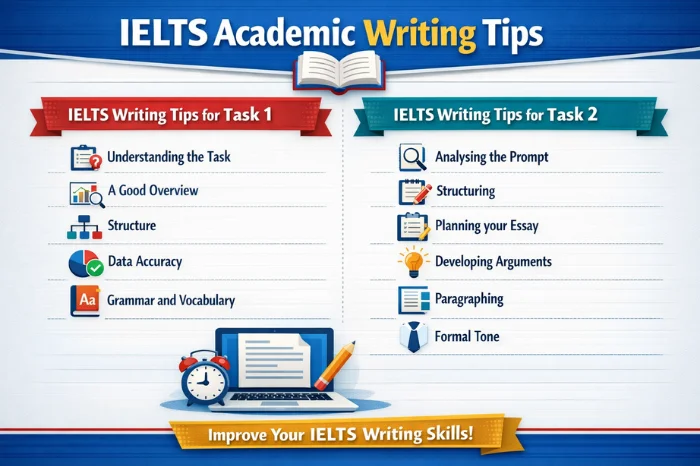
The IELTS Academic Writing Tips for Task 1:
-
Understanding the Task: you need to report on the data tables, charts, graphs, or a map, and should not write any opinion-based things.
-
A Good Overview is essential to get a band 7 or higher. Focus on the main teens here.
-
Structure: introduction, overview, 2-3 body paragraphs.
-
Data Accuracy: always ensure that the data is reported very clearly, with well-defined comparisons, rather than just listing the numbers.
- Grammar and Vocabulary: use the best vocabulary to describe different trends.
IELTS Writing Tips for Task 2:
-
Analysing the Prompt: identify the prompt type and underline the key keywords.
-
Structuring: introduction, body1, body2, conclusion
-
Planning your Essay: spend 5 to 10 minutes planning the main arguments of your essay with supporting examples.
-
Developing Arguments: all paragraphs must have a very clear topic sentence followed by proper expansion.
-
Paragraphing: Do not use bullet points; rather, use very clear paragraphs to separate the ideas.
- Formal Tone: avoid any contradictions, and use bad words instead; write in a formal academic tone.
Need expert academic support? Say “write my essay for me” and get a well-researched, plagiarism-free essay today.
Effective Strategies to Improve IELTS Speaking Skills
IELTS preparation strategies to improve English speaking skills are as follows:
-
Daily Practice with Recording: you can pay off your debt by listening to good English recordist phrases.
-
Task Part 2 Perception: speak for 2 minutes on very common topics like travel or education. Do this in a 1-minute preparation strategy.
-
Use the Shadowing Technique: listen to native English speakers to imitate their speed, accent, and rhythm.
-
Expanding Active Vocabulary: try to learn as many synonyms as possible, as well as idiomatic expressions, to avoid repeated words.
-
Structure your Answer: for part three, use a structure like the answer
-
Talk With a Speaking Partner: find one with whom you can converse and practice English every day.
- Focus More on Fluency than Perfection: in the speaking section, you need to focus more on English speaking fluency than on difficult words with perfection.
What are the Most Common IELTS Speaking Topics?
-
Hometown and Neighbourhood: describing your house, neighbourhood, etc.
-
Work and Area: describing your qualification, education, current job, etc.
-
Social Media and Technology: discussing the various apps used by you
-
Studies: telling about your school, college, university, subject of major, and spot on.
-
Hobbies: This describes how you spend your leisure time, such as reading, writing, sports, music, etc.
-
Travel and Tourism: if you are a good backpacker, write about your various travelling experiences in different destinations
-
Family and Friends: write about your family and friends circle
-
Food and Cooking: write about your favourite meals, cooking skills, etc.
-
Memories and Life Events: Describe an asocial event or a moral incident in your life
- Nature and Environment: describe various environmental issues, pollution, and conservation.
Need Help with AssignmentTask? Professional Support for IELTS Success
You can see from this blog that IELTS preparation for international students is not easy. Thus, you always need the best online IELTS essay writing service provider in this regard. AssignmentTask.com is always the very best choice for you in this respect. We are always the No.1 online essay service provider all around the world. Our team of experts will always help you in the best possible way in your IELTS preparation. We always assure top scores, 100% customer satisfaction.

Lisa K. Hook